You wait on hold for 20 minutes. You repeat your issue to three different people. Sound familiar? Many customers face these frustrations daily.
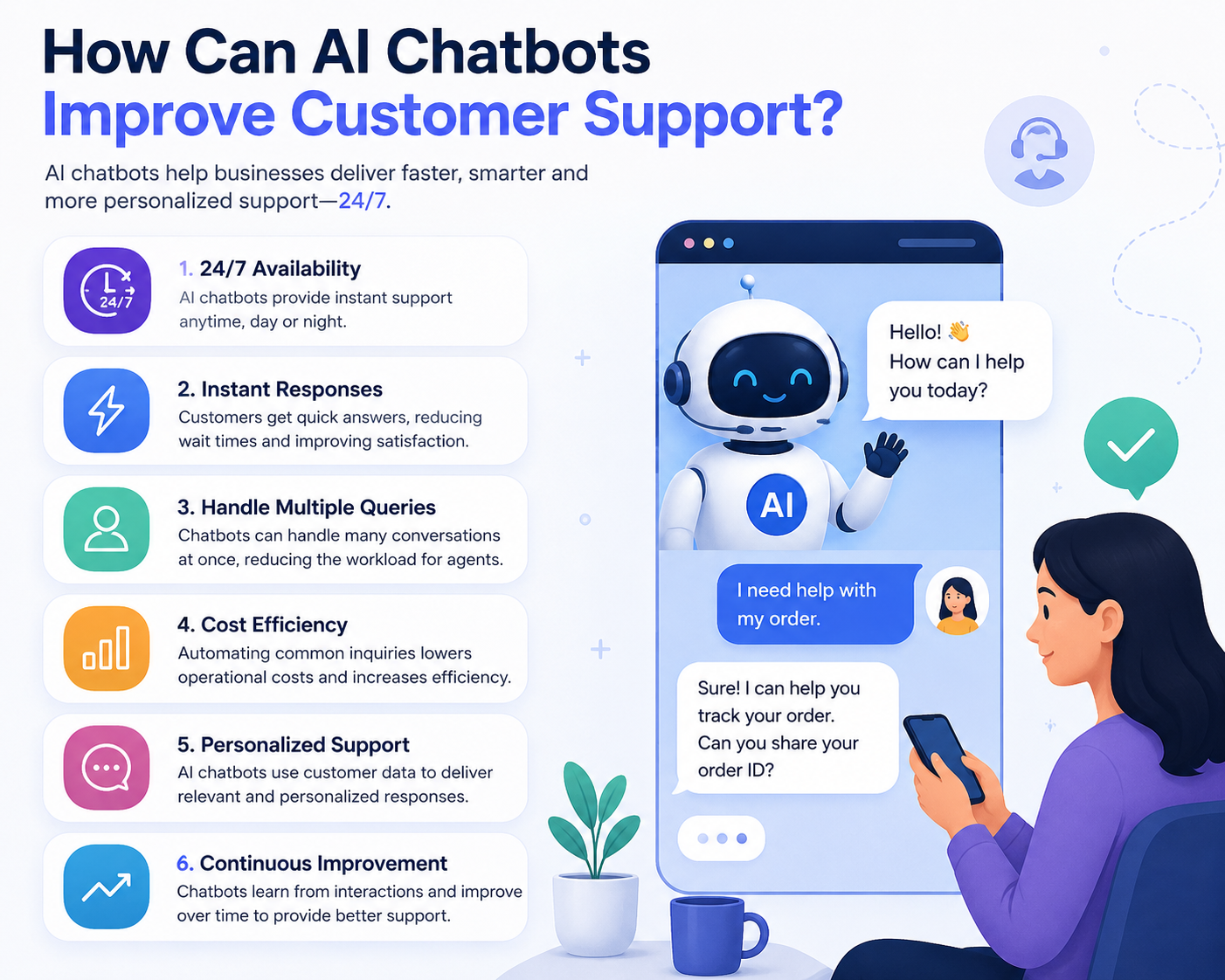
Businesses struggle with high support volumes, limited staff, and rising expectations for instant help. AI chatbots solve these problems. They deliver fast, accurate responses around the clock.
Read this article to discover practical ways AI chatbots boost your customer support. You will learn real benefits, implementation steps, examples, and strategies to cut costs while raising satisfaction.
What Makes AI Chatbots Powerful in Customer Support
AI chatbots use natural language processing and machine learning to understand and respond to customer questions. They go beyond simple rule-based scripts. Modern chatbots learn from interactions and improve over time.
You get consistent service that never tires. Customers receive answers in seconds instead of hours.
Key capabilities include:
- 24/7 availability
- Handling multiple conversations at once
- Personalizing responses based on customer history
- Escalating complex issues to human agents smoothly
Businesses in Bangladesh and worldwide now use these tools to stay competitive. Bangla AI chatbots, for example, handle local language needs effectively and qualify leads without extra staff.
How Can AI Chatbots Improve Customer Support? Core Benefits
AI chatbots transform support operations. Here is how they deliver results.
Faster Response Times
Customers hate waiting. AI chatbots reply instantly.
Studies show they cut response times dramatically. One case reduced average handling from 8 hours to 5 minutes. Another achieved 90% faster replies.
You give customers immediate help. This reduces frustration and abandoned carts.
Real impact:
- Average first response drops from minutes to seconds
- Peak-hour overload disappears
- Follow-up questions decrease because answers are clear
24/7 Availability Without Extra Costs
Your team sleeps. Your chatbot works.
Customers shop and need help at any hour. Chatbots provide support during nights, weekends, and holidays.
This matters for global businesses and those in different time zones. One airline resolved 80% of inquiries without humans and cut response times by 90%.
Cost Savings and Efficiency
Support costs drop significantly. Chatbots handle up to 70-80% of routine inquiries.
Businesses report 30% savings on support costs. Some see up to 80% reduction per interaction. You free agents for high-value tasks. This lowers hiring needs and training expenses.
ROI example: Many companies achieve payback within 3-6 months. One organization saved an estimated $10,000 monthly.
Higher Customer Satisfaction
Speed and accuracy build loyalty. Customers prefer chatbots for simple issues. 69% now choose them for quick resolutions.
Satisfaction scores rise. One implementation lifted CSAT by 22%. Another improved scores from 3.7 to 4.4.
You create positive experiences that encourage repeat business and referrals.
Personalized Interactions
Chatbots access customer data to tailor responses. They remember past purchases and preferences.
You make customers feel valued. A retail chatbot suggests relevant products. A bank chatbot offers account-specific advice.
This personalization increases engagement and conversion rates.
Scalability During Peaks
Black Friday sales or product launches spike inquiries. Chatbots manage thousands of chats simultaneously.
Your human team stays focused. No more overwhelming queues.
Real-World Examples of AI Chatbots in Action
Amtrak’s Julie: This virtual assistant handled over 5 million requests in one year. It increased self-service bookings by 25%.
Sephora: Their chatbot boosted customer engagement by 30%.
Bank of America’s Erica: It resolved questions in 41 seconds on average for millions of interactions.
Bangladesh context: Local businesses use Bangla AI chatbots for retail and e-commerce. They manage orders, answer FAQs, and reduce staff workload while speaking customers’ language.
How Can AI Chatbots Improve Customer Support? Implementation Steps
You want results. Follow these practical steps.
- Define Clear Goals Identify high-volume routine questions. Focus on FAQs, order tracking, and basic troubleshooting first.
- Choose the Right Platform Look for tools with strong NLP, easy integration, and analytics. Consider custom solutions for specific needs.Explore services from an AI development company that builds tailored chatbots.
- Train Your Chatbot Feed it your knowledge base, past tickets, and product info. Test with real scenarios.
- Integrate with Existing Systems Connect to CRM, order databases, and helpdesk tools for seamless context.
- Design Smooth Handoffs Let customers request humans easily. Transfer full conversation history.
- Monitor and Improve Track metrics daily. Update based on performance and feedback.
Read more on how AI-powered business automation works to integrate chatbots effectively.
Key Metrics to Track Success
Use these numbers to measure impact.
| Metric | Target Improvement | Why It Matters |
|---|---|---|
| Response Time | 50-90% reduction | Faster help increases satisfaction |
| Resolution Rate | 60-80% by chatbot | Fewer escalations save costs |
| CSAT Score | +10-22 points | Shows real customer happiness |
| Cost per Interaction | 30-80% lower | Direct bottom-line benefit |
| Containment Rate | 40-70% | Measures automation success |
Review these weekly. Adjust your chatbot accordingly.
Challenges and How to Overcome Them
AI chatbots are not perfect. Address these issues head-on.
Complex Queries: Chatbots struggle with nuance. Solution: Set clear escalation rules. Keep humans ready for emotional or detailed cases.
Customer Trust: Some prefer people. Solution: Be transparent. Offer easy switch to agents. Use friendly, natural language.
Data Privacy: Protect information. Solution: Follow regulations and use secure systems.
Integration Issues: Old systems resist. Solution: Work with experts. Start small and scale.
For businesses in Bangladesh, AI helps overcome local challenges like language and resource limits.
Advanced Features to Add Value
Take your chatbots further.
- Voice Integration: Handle calls naturally.
- Sentiment Analysis: Detect frustration and escalate early.
- Proactive Messages: Reach out before issues grow.
- Multilingual Support: Serve diverse customers.
Custom AI solutions make these features fit your exact business. Learn about custom AI solutions for businesses.
Comparison Table: Traditional Support vs AI Chatbots
| Aspect | Traditional Support | AI Chatbots |
|---|---|---|
| Availability | Business hours | 24/7 |
| Response Speed | Minutes to hours | Seconds |
| Cost | High per interaction | Low after setup |
| Scalability | Limited by staff | Handles thousands |
| Consistency | Varies by agent | Always on-brand |
| Personalization | Manual | Data-driven |
AI chatbots win on efficiency. Combine both for best results.
Best Practices for Long-Term Success
You build better support with these habits.
- Start with simple use cases.
- Test thoroughly before full launch.
- Gather customer feedback regularly.
- Update knowledge base often.
- Train your team to work alongside chatbots.
- Maintain human oversight for quality.
Disclose when customers chat with AI. This builds trust.
Future Trends in AI Customer Support
Voice AI grows fast. Multimodal chatbots combine text, images, and voice. Predictive support anticipates needs before customers ask.
Agentic AI will resolve more issues autonomously. By 2029, experts predict 80% of common interactions handled without humans.
Businesses that adopt early gain advantage. Start planning now.
Actionable Checklist for You
- Audit your current support tickets. Find top 20 questions.
- Calculate current costs per interaction.
- Set success KPIs before launch.
- Pilot with one department.
- Measure results after 30 days.
- Scale what works.
You control the outcome. Small steps deliver big improvements.
Resources for Deeper Learning
Final Thoughts on Implementation
How can AI chatbots improve customer support? They deliver speed, scale, and savings while letting your team focus on what matters most — building relationships.
You now have the knowledge. Take the first step today. Review your support processes. Identify quick wins for automation. Partner with experts if needed.