Introduction
Businesses lose billions to manual workflows every year. Data entry errors, missed deadlines, and repetitive tasks drain resources that could fuel growth. AI-powered business automation transforms how companies operate by handling complex processes at machine speed. Companies using automation report 30-40% faster task completion and reduced operational costs. This guide explains how AI-powered business automation works, why it matters, and how to implement it in your organization.
| Key Insight: How does AI-powered business automation work? It combines machine learning algorithms, data processing, and decision-making logic to execute tasks without human intervention, reducing errors and accelerating operations. |
What Is AI-Powered Business Automation?
AI-powered business automation combines artificial intelligence with workflow automation to execute tasks that normally require human decision-making. Unlike basic automation tools that follow rigid scripts, AI systems learn from data patterns and adapt their responses based on real-world scenarios.
The difference is crucial. Traditional automation can fill out forms or send emails on schedule. How does AI-powered business automation differ? It analyzes customer behavior, predicts outcomes, and makes complex decisions without predefined rules.
Core Components of How AI-Powered Business Automation Works
Understanding how does AI-powered business automation work requires examining its fundamental components.
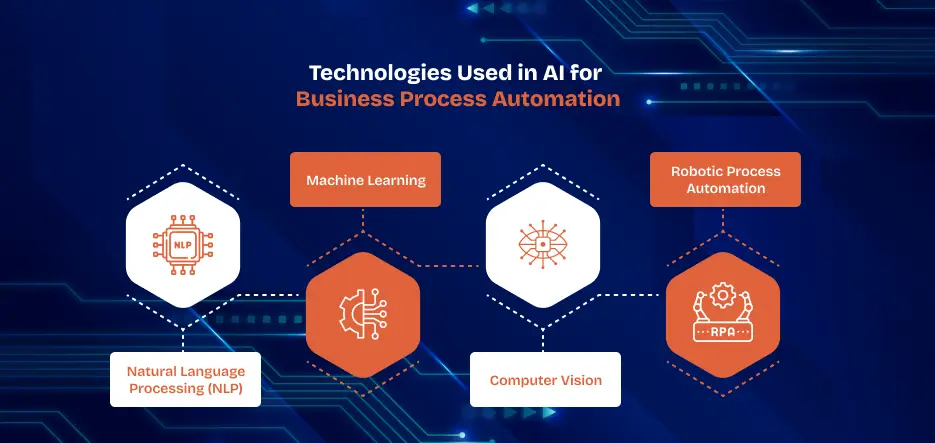
Machine Learning Engines
Machine learning sits at the heart of AI-powered business automation. These engines process historical data to identify patterns and make predictions. They improve continuously as new data flows in.
• Supervised learning: Train algorithms on labeled data to predict specific outcomes
• Unsupervised learning: Discover hidden patterns in unstructured data
• Reinforcement learning: Systems improve through trial and error feedback loops
Natural Language Processing
NLP enables AI to understand and generate human language. This powers chatbots, email classification, sentiment analysis, and document processing within automated workflows.
Robotic Process Automation
RPA handles repetitive digital tasks across applications. Combined with AI, RPA bots can now handle complex decisions, not just follow linear sequences.
Data Pipelines and Integration
Effective AI automation requires seamless data flow. Data pipelines collect information from multiple sources, clean it, and feed it into decision-making systems in real time.
Real-World Examples: How AI-Powered Business Automation Works
See how different industries leverage how does AI-powered business automation work in practice:
| Industry | Application | Impact | Time Saved |
| Banking | Loan approval, fraud detection | 95% faster decisions | 8+ hours/day |
| E-commerce | Inventory management, recommendations | 20% revenue lift | 5+ hours/day |
| Healthcare | Patient scheduling, diagnostic support | 40% fewer errors | 6+ hours/day |
| Manufacturing | Predictive maintenance, quality control | 35% downtime reduction | 10+ hours/day |
The Process: How AI-Powered Business Automation Works Step by Step
1. Data Collection and Preparation
The first step gathers data from your business systems, databases, and customer interactions. Data is cleaned to remove duplicates, errors, and irrelevant information. Quality data determines AI performance, so this phase is critical.
2. Model Training
AI engineers feed prepared data into machine learning models. These models learn patterns, correlations, and decision rules. Training involves multiple iterations, testing different algorithms to find the best performer.
3. Integration into Workflows
Trained models connect to your existing systems. APIs, integrations, and connectors link the AI engine with CRM, ERP, accounting software, and communication platforms.
4. Real-Time Decision Making
When a trigger event occurs, the AI system analyzes incoming data instantly. It applies learned patterns to make decisions, classify information, or predict outcomes without human involvement.
5. Continuous Monitoring and Improvement
The system tracks its decisions and outcomes. When performance drops or new patterns emerge, the model retrains automatically. This continuous learning ensures the automation stays accurate over time.
Key Benefits of AI-Powered Business Automation
• Cost Reduction: Eliminates manual labor for repetitive tasks, cutting operational expenses by 30-50%
• Error Elimination: AI systems maintain consistency and accuracy that humans cannot sustain over long periods
• Speed: Tasks that took hours complete in minutes or seconds
• Scalability: Handle increased volume without proportional cost increases
• Data-Driven Insights: Unlock patterns in data that guide better business decisions
• Employee Satisfaction: Free staff from tedious work to focus on strategic tasks
What Services Does an AI Development Company Provide?
Building AI-powered business automation requires expertise beyond internal teams. Specialized AI development companies offer comprehensive services:
Assessment and Strategy
Consultants analyze your processes to identify automation opportunities. They map workflows, assess data readiness, and recommend AI solutions aligned with your goals.
Model Development
Engineers build custom AI models using your data. They choose appropriate algorithms, optimize parameters, and validate performance before deployment.
System Integration
Technical teams connect AI systems with your existing software. They ensure data flows correctly and automation triggers work reliably.
Ongoing Support
After launch, providers monitor performance, retrain models as data changes, and optimize automation rules based on business results.
How AI Can Help Businesses in Bangladesh
Bangladesh is positioned at the intersection of rapid growth and labor cost challenges. AI-powered business automation addresses these directly.
| Bangladesh Opportunity: With rising wages and competitive pressure, Bangladeshi companies can maintain cost advantage while improving quality through AI automation. This creates competitive advantage in global markets. |
Manufacturing Optimization
Textile and apparel companies use AI for quality inspection, defect detection, and production scheduling. Automation reduces waste and improves compliance with international standards.
Customer Service at Scale
Bangladesh’s BPO industry processes customer service for global brands. AI chatbots and automation tools increase throughput while reducing training time for new agents.
Supply Chain Intelligence
Trading companies and exporters use AI to forecast demand, optimize logistics, and track shipments. This reduces delays and improves cash flow.
How to Implement AI-Powered Business Automation in Your Organization
6. Start Small
Pilot programs reduce risk. Choose one high-impact process that generates clear ROI. Avoid organization-wide implementations on first attempt.
7. Ensure Data Quality
Audit your data systems before starting. Clean, organized, accessible data is non-negotiable for AI success.
8. Get Stakeholder Buy-In
Employees worry about job displacement. Show how automation eliminates tedious work and creates better jobs. Involve team leaders early.
9. Choose the Right Partner
Work with experienced AI development companies that understand your industry. Check case studies and references carefully.
10. Monitor and Iterate
Track KPIs closely. Be prepared to adjust settings, retrain models, and optimize workflows based on real results.
Overcoming Common Challenges
Legacy System Integration
Older systems don’t talk to modern AI platforms. Solution: Use middleware and API wrappers to bridge gaps without replacing infrastructure.
Insufficient Data
AI needs volume to learn. Solution: Start with synthetic data, combine multiple sources, or begin with less complex models that require less training data.
Change Management
Employees resist new systems. Solution: Involve them early, provide training, and celebrate early wins to build momentum.
Cost Concerns
Initial investment feels high. Solution: Focus on processes with clear ROI. A single high-value automation often pays for entire projects in months.
AI Automation vs. Traditional Automation: Comparison
| Aspect | Traditional Automation | AI-Powered Automation |
| Decision Making | Rule-based | Adaptive, learns from data |
| Complexity | Simple, linear processes | Complex, contextual decisions |
| Adaptability | Requires manual recoding | Improves automatically |
| Use Cases | Data entry, scheduling | Predictions, classification |
The Future of AI-Powered Business Automation
AI automation technology evolves rapidly. Emerging trends shape how businesses will automate in coming years.
Autonomous Decision Making
Future systems will make decisions involving budget allocation, hiring recommendations, and strategic planning with minimal human oversight.
Explainable AI
Companies will demand transparency. Why did the system make that decision? Explainable AI shows reasoning, building trust with stakeholders.
Edge AI
Processing happens locally on devices rather than cloud servers. This enables real-time decisions, better privacy, and reduced latency.
Industry-Specific Models
Pre-built models for specific industries reduce implementation time. Instead of building from scratch, companies deploy ready-made solutions tailored to their sector.
Learn More About AI Business Solutions
Explore how AI development services transform operations:
• Comprehensive AI Development Services Guide
• AI Solutions for Bangladesh Businesses
Additional Resources
For deeper understanding of AI automation concepts:
• McKinsey: The Future of Automation
• Gartner: Robotic Process Automation Defined
• IBM: Understanding Machine Learning
Conclusion
How does AI-powered business automation work? It combines data analysis, machine learning, and intelligent decision-making to execute complex tasks at scale. The technology transforms how companies operate, reducing costs, eliminating errors, and freeing teams for strategic work.
The transition isn’t simple. It requires quality data, experienced implementation partners, and organizational commitment. However, companies that start today gain competitive advantage tomorrow.
Your next step is assessing where automation creates highest impact in your business. Start with one process. Get quick wins. Build momentum. The future of work is automated.
| Ready to Transform Your Business? Contact an AI development expert to discuss how AI-powered business automation can solve your specific challenges. Learn which processes deliver immediate ROI. |
About This Article
This comprehensive guide explores how AI-powered business automation works, from core components to real-world implementation. We cover the technology, benefits, challenges, and future trends. Whether you’re evaluating automation for your organization or building AI solutions, this resource provides actionable insights backed by industry data and practical examples.