Introduction
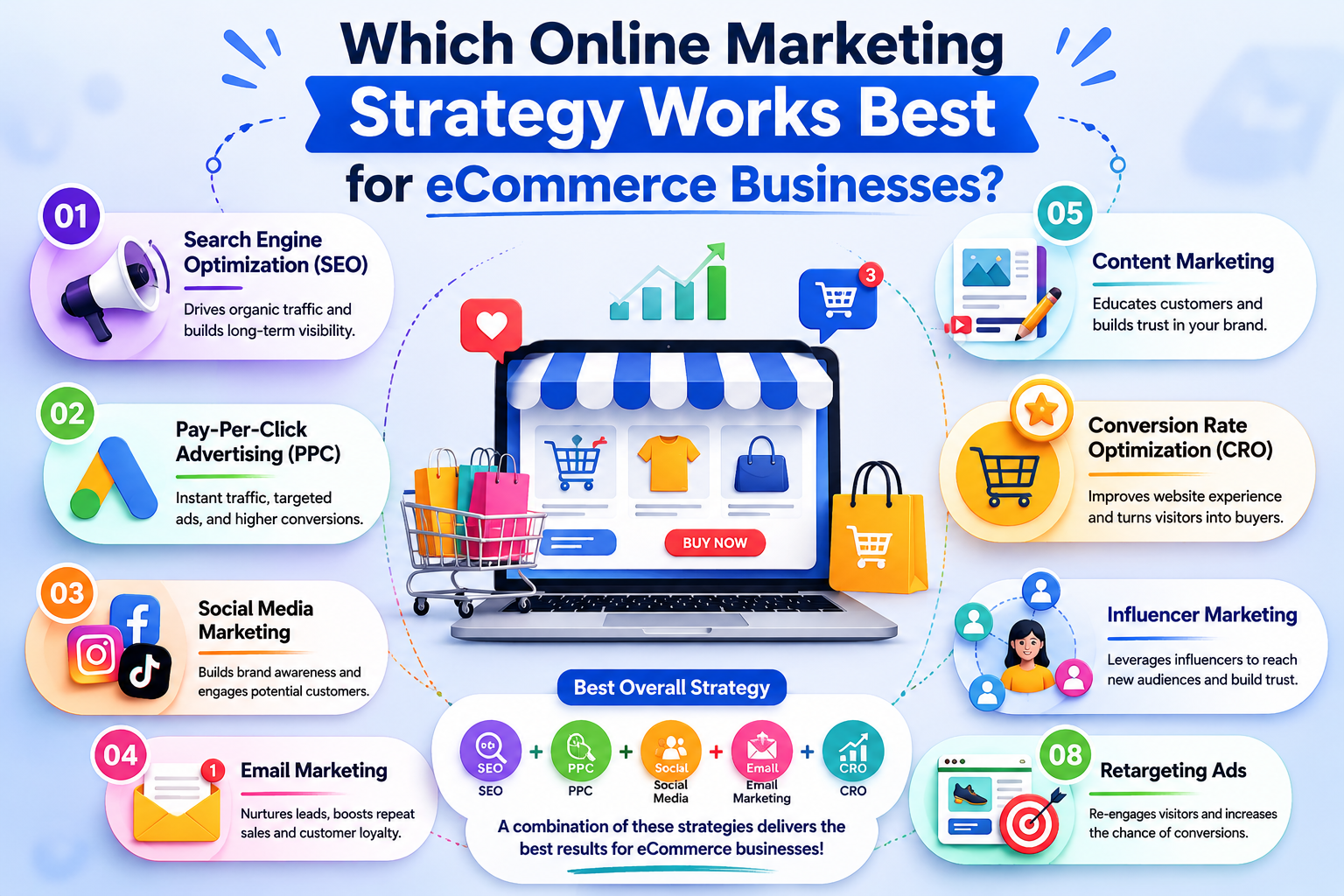
Many eCommerce owners struggle to drive consistent sales online. Competition grows daily, ad costs rise, and customer attention spans shrink. The solution lies in choosing the right mix of proven strategies tailored to your goals. This article explores which online marketing strategy works best for eCommerce businesses. You will gain practical insights, real data, comparisons, and steps you can apply immediately to increase traffic, conversions, and revenue.
Understanding the eCommerce Marketing Challenge
eCommerce businesses face unique hurdles. High cart abandonment rates average around 70%. Organic reach on social platforms has declined. Paid ads deliver quick results but eat into margins without proper optimization.
You need strategies that deliver both short-term wins and long-term growth. No single tactic fits every store. Success comes from combining channels based on your audience, products, and budget.
Key Factors That Determine the Best Strategy
- Your target audience demographics and behavior
- Product type and price point
- Current website traffic sources
- Available marketing budget
- Sales cycle length
Related keyword integration: Effective digital marketing for online stores requires alignment across SEO, paid search, content, email, and social channels.
Why a Multi-Channel Approach Often Wins
Data shows integrated strategies outperform single-channel efforts. Businesses using three or more channels see higher customer lifetime value.
You can start small and scale what works. Track everything with tools like Google Analytics.
SEO: The Foundation for Sustainable eCommerce Growth
H2: Why SEO Remains One of the Best Online Marketing Strategies for eCommerce Businesses
SEO drives nearly 53% of eCommerce website traffic on average. Organic search delivers qualified visitors who intend to buy.
Benefits you gain:
- Lower long-term costs compared to paid ads
- Builds authority and trust
- Compounding results over time
How to Implement Technical SEO for Your Store
- Optimize site speed. Aim for under 3 seconds load time.
- Use proper schema markup for products.
- Create mobile-friendly design.
- Fix crawl errors and duplicate content issues.
Internal link: Learn more about technical foundations in our guide on how SEO can help small businesses grow online in Bangladesh.
On-Page and Content Optimization Tactics
Focus on product pages first. Include target keywords naturally in titles, descriptions, and headings. Add high-quality images with alt text.
Create blog content around buyer questions. For example, “How to choose the right running shoes” for a footwear store.
Case study example: One eCommerce site increased organic traffic 10x in 8 months through targeted keyword research and content. Revenue rose from under $100 to nearly $4,000 monthly.
Internal link: Master the basics with why keyword research is important for SEO success.
Local SEO for Regional eCommerce Success
If you serve specific areas, claim Google Business Profile and optimize for local searches.
Internal link: Explore details in why local SEO is important for businesses in Dhaka.
External link: For advanced tools, check Google Search Central guidelines.
PPC Advertising: Fast Results with Measurable ROI
H2: Is PPC the Best Online Marketing Strategy for Quick eCommerce Sales?
PPC delivers immediate visibility. Google Ads often accounts for significant portions of retail search spend.
Key advantages:
- Target high-intent buyers
- Control budget daily
- Track exact ROI
Average ROAS for well-managed campaigns exceeds 4:1 in many niches.
Setting Up Effective Google Shopping Campaigns
Use product feeds with accurate titles, descriptions, and pricing. Enable Performance Max for broader reach.
Retargeting tip: Show ads to cart abandoners with special offers. This can lift conversions significantly.
External link: Study benchmarks at WordStream eCommerce reports.
Budget Allocation and Testing
Start with 20-30% of marketing budget on PPC. Test ad copy, landing pages, and audiences. Scale winners.
Monitor metrics: CTR, CPC, conversion rate, and ROAS.
Email Marketing: Highest ROI Channel for Retention
H2: Email Marketing – Why It Delivers the Best Long-Term Results for eCommerce
Email marketing generates $36 to $42 for every $1 spent on average. Some eCommerce brands achieve $79 ROI.
You own the list. No algorithm changes affect delivery.
Building and Segmenting Your Email List
Offer lead magnets like discounts or guides. Segment by purchase history, location, and behavior.
Automation flows to implement:
- Welcome series
- Abandoned cart
- Post-purchase upsells
- Re-engagement for inactive subscribers
Data point: Abandoned cart emails can generate up to 30x more revenue than standard campaigns.
Personalization and Compliance
Use first names and past purchase data. Follow GDPR and CASL rules.
Internal link: Partner with experts at Kreatech – Best 360 Digital Marketing Agency in Bangladesh for full-funnel support.
Social Media and Influencer Strategies
H2: Social Commerce – Engaging Audiences Where They Shop
Platforms like Instagram and TikTok support direct checkout. Short video content performs strongly.
Best practices:
- Maintain 80/20 value-to-promotion ratio
- Use user-generated content
- Run targeted ads
External link: Review platform trends on Sprout Social Index.
Content Marketing and Influencer Partnerships
Create guides, videos, and comparisons. Collaborate with micro-influencers for authentic reach.
Comparing Strategies: Tables and Data
Table: Marketing Strategy Comparison for eCommerce
| Strategy | Time to Results | Avg ROI | Best For | Cost Level |
|---|---|---|---|---|
| SEO | 3-12 months | High long-term | Sustainable traffic | Medium |
| PPC | Immediate | 4:1+ | Quick sales | High |
| Ongoing | 36:1+ | Retention & repeat sales | Low | |
| Social | 1-3 months | Variable | Brand awareness | Medium |
Implementation Roadmap for Your Business
- Audit current performance.
- Set clear KPIs.
- Allocate budget 40% SEO/content, 30% paid, 20% email, 10% social testing.
- Review monthly and adjust.